
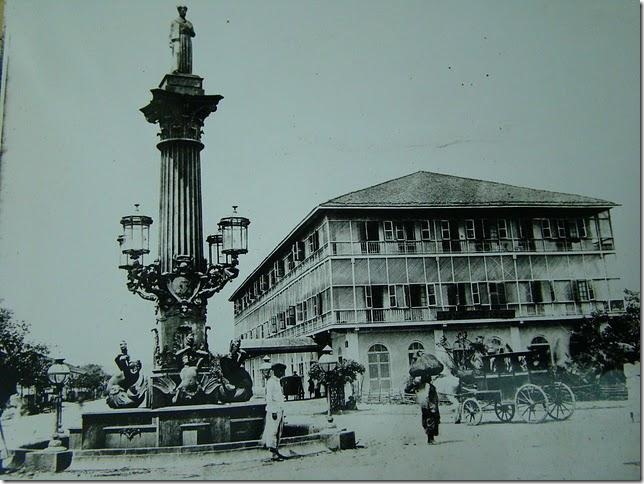
The below letter from 1966 is shared with us by Ms. Minnie Boga of Delhi. The letter was originally written by her grand uncle Ardeshir C. M. Cursetjee and grand aunt Behroze J. M. Cursetjee when the Bombay Municipal Commission had proposed to remove the statue of Cursetjee Manockjee Shroff, the Khada Parsee of Bombay.
The original scanned copy of the letter was forwarded to us by Ashdeen Lilaowala.
Telephone d. 735
1 Colaba Road 1 Colaba Road,
BOMBAY, 5. 10th March 1966.
To
Shri S. E. Sukthankar, I.A.S.,
Municipal Commissioner,
Municipal Head Office,
Cruickshank Road,
BOMBAY, 1.
Sir,
Proposed removal of the statue of Cursetjee Manockjee Shroff, the Khada Parsee of Bombay.
- We, Ardeshir C. M. Cursetjee and Behroze J. M.. Cursetjee are son and daughter respectively of the two sons of Manockjee Cursetjee – Cursetjee and Jehangir and Amy B. H. J. Rustomjee, grand-daughter of Jehangir Manockjee Cursetjee.
- Manockjee Cursetjee was the youngest son of Cursetjee Manockjee Shroff and the donor of the memorial column and statue to Bombay, now known as Khada Parsee.
- We understand from your letter of the 23rd February 1966 that it is proposed to remove the Khada Parsee from its present position at the south end of Byculla Bridge and re-erect it at Nagpada.
- As direct descendants of Cursetjee Manockjee Shroff, we strongly protest against the proposal to remove this statue from its prominent position and re-erect it in a little known garden in Nagpada.
- You will pardon our going into great length, but unless we speak fully our protest will be considered merely as a personal one of pride in an ancestor.
- Cursetjee Manockjee Shroff was born on or about the 19th August 1763 (more than 200 years ago). He died on the 7th May 1845. The citizens of Bombay— Christians, Hindus, Jews, Muslims and Parsees mourned his loss and paid homage to him.
- Cursetjee Shroff was not wealthy, but he was a true benefactor and one of the makers of Bombay. He was a businessman, a ship owner, a banker (Shroff) and one of the principal members of the Parsee Panchayat. His whole life was one endless stream of benefactions, without publicity. Army men and small traders when in want, all came to him for help. Even when they had differences on other points with their families or in business, they would come to Cursetjee Shroff to settle their differences and accept his decision rather than go to a court of law.
- History is forgotten, and the written word is often not easily available. But what has been mentioned by word of mouth from father to son and grandson and great-great-grand sons and daughters cannot be overlooked. These unwritten records must be respected.
- When Cursetjee Manockjee Shroff died in 1845, he left a small legacy of Rs. 30,000 to his youngest son Manockjee. Manockjee had been given a good education by his father. He became a pleader and one of the first Indians to be a judge of the Small Causes Court. He was the first Indian to be created Sheriff and was the only one to be twice created Sheriff. He dropped the surname Shroff as he was no longer pursuing the business of a banker. His branch were all known thereafter as Cursetjee.
- Even in 1845, Manockjee Cursetjee did not believe in inheritance. He refused to be ‘his father’s pensioner’. He had in mind the perpetuation of the memory of a great and noble citizen.
- In 1862 Manockjee Cursetjee was in London and visited the International Exhibition. He saw there a fountain erected by Messrs. Coalbrookdale Company for the Chilian Government. The work was executed by one John Bell. It consisted of an elegant Corinthian column surmounted by a richly decorated capitol, the abascus of which supported a plinth whereon stood the figure of the Goddess of Spring.
- Manockjee was struck with the grandeur of th nonument -and immediately ordered a similar one as a memorial to his father, but instead of the goddess surmounting the column, the statue of his father was introduced. The price paid was Rs. 20,000.
- The statue was delivered in Bombay in 1867. In 1867 or 1868 the statue was erected and handed to the Bombay Municipality for maintenance and preservation. The memorial bears the coat-of-arms (a pair of scales of justice, a pen and the words Trust in God and be not daunted’) of the donor, Manockjee Cursetjee.
- In 1867 it was erectcd at the junction of Bellassis Road, Clare Road, Duncan Road, Ripon Road and East Bellassis Road at Nagpada. The land, it is said, had been formally a pond owned by Cursetjee Manockjee Shroff. The pond was filled up.
- At that time, that part of the city was most important. Government House wasat Parel (the present Haffkine Institute). The Pcemchand Roychands, the Sassoons id many other prominent people had their residences in Byculla. The Byculla ( jb was on Bellassis Road. Other businessmen lived in the business area of the Fort, where Cursetjee Manockjee Shroff had his residence.
- In 1928 the Bombay Municipality found that the column and statue obstruct the erection of overhead wires which were necessary for running the electric tramways. The Municipal Commissioner consulted Mr. C. M. Cursetjee, Bar-at- Law, retired judge of the Small Causes Court, and grandson of the Khada Parsee (M. C. was the father of Ardeshir, one of the subscribers to this protest) about where the memorial should be erected. The site at the south end of Byculla Bridg (as approved of by Mr. C. M. Cursetjee) was selected and the memorial re-erected at that site in 1928-29. The Municipality incurred a cost of about Rs. 4,500 for removing and re-erecting the column and statue. It may be mentioned that when the statue was re-erected the column was reduced to two-thirds of its original height.
- When it was removed in 1928 it was replaced in a prominent thoroughfare, where thousands passed it daily. Some knew who it was. Many even today as they pass by pay their respects with admiration to a great citizen of a bygone time and particularly to an imposing monument.
- Our reasons for the protest are:
- (a) A man was born more than 200 years ago. He served the city and died 120 years ago; he must not be forgotten.
- (b) Another great citizen, his son Manockjee Cursetjee, a reformer, a promoter of female education, one who did not believe in inheritance, donated to the City, as a mark of filial duty a memorial to his father. The object was not merely pride in being the son, but that the future citizens may look up and admire the artistic beauty of the column and inquire and learn of a great countryman, one of the builders of Urbs prima in hides.
- (c) The Bombay Municipal Act was passed in 1865. The Khada Parsee must have been one of the first memorials erected in the City after the Corporation was formed and the Corporation undertook to preserve it.
- (d) The Municipality has an obligation to the past as well as the present. Such a memorial cannot be hidden away in a small garden frequented only by residents of that locality.
We trust, Sir, we have convinced you and the Corporators of our City of the reasonableness of our protest.
If there be any slight inaccuracies in dates and names of places, kindly overlook such mistakes.
BEHROZE J. M. CURSETJEE
AMY B. H. J. RUSTOMJEE
0 Comments